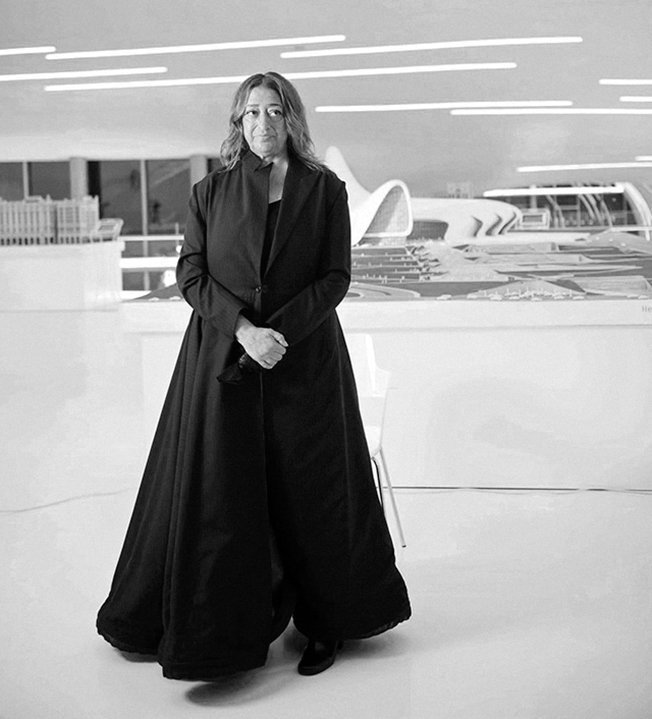
ZAHA HADID L’ESEMPIO VIVENTE DELLA COESIONE TRA ORIENTE E OCCIDENTE
Certo che scrivere un articolo con questo titolo per i giorni che stiamo vivendo, è un bello smacco, è una cosa da Blog Baxter! In questi anni che i potenti del mondo, da oriente ad occidente, si fanno una guerra di supremazia, c’è stata una donna che con la sua vita e le sue opere architettoniche di fama mondiale, ha lasciato un messaggio potente e bello insieme:
oriente e occidente sono complementari, ed insieme posso dare forma alla vita.
Questa è la storia di Zaha Hadid, nata a Beirut nel 1950 da una famiglia benestante, naturalizzata britannica, dove ha studiato architettura, approfondendo lo studio decostruttivista. Londra è anche la città in cui ha fondato il suo studio Zaha Hadid Architets. Viene riconosciuta nel mondo dell’architettura, infatti i premi sono numerosi, ma gli inizi sono stati una specie di mongolino d’oro. Infatti la nominavano “l’architetto di carta” vinceva i premi, ma non i cantieri, perché tutte quelle linee sinuose che non mettevano confini tra l’interno e l’esterno dei suoi edifici, era un concetto ancora all’avanguardia per il mondo delle costruzioni.
Così come ogni pioniere continuò la sua strada, con la sua visione, di certo non si può cambiare la propria natura e rimpicciolirsi per piacere agli altri. Lo stesso fece Zaha Hadid e gli anni e la tenacia le diedero ragione, tanto da riuscire a sfondare il muro della diffidenza e quei bellissimi progetti oltre che su carta presero vita nel mondo. Ne sono un esempio Vitra Fire Station in Germania tra i suoi primi progetti, il MAXXI a Roma e il suo ultimo progetto The Opus a Dubai.
Insomma, di strada ne ha fatta Zaha Hadid, ma quel che vorrei far emergere da questo articolo non è tanto l’architetto che era, e sì non le piaceva che la chiamassero architetta o architetto donna, in tutte queste stronzate da femminista imbecille, non ci voleva entrare. Sapeva bene che era una donna che lavorava in un ambiente prevalentemente maschile, e perdersi in queste cazzate, le avrebbe solamente fatto perdere tempo e dato palle al balzo agli avversari. Le sue opere architettoniche e la tenacia, mescolate al tempo le avrebbero dato ragione. E così è successo.
È stata architetto femminista con la sua vita, senza slogan ed isterismi, solo le sue armi, le più potenti al mondo: la sua immaginazione e le competenze che hanno dimostrato a tutti che si potevano rompere gli schemi, e la linea retta caposaldo dell’architettura.
Ha dimostrato che si poteva essere funzionali senza perdere la connessione con la propria immaginazione, che l’interno e l’esterno di un edificio potevano essere connessi. Che le facciate potevano andarsene in pensione come una mentalità troppo rigida e lineare.
Zaha Hadid è partita dall’umanità per costruire un edifico destinato alle persone
come il concetto di pelle, che è stata la sua firma d’autore. La pelle che è confine di un essere umano, che delinea differenze tra gli esseri umani, ma che nelle sue costruzioni diventava una linea continua, dove l’interno e l’esterno non avevano più confini, ovunque era un posto da vivere.
E vorrei concludere riflettendo insieme, che non è forse un caso che i primi edifici di Zaha Hadid ad esistere davvero nel mondo, fossero destinati all’arte e alla cultura. Quegli ambienti che per vocazione vivono nell’anticipazione, che hanno sempre fatto del non-ancora il loro territorio naturale e reso celebri quegli esseri umani avanguardisti e strani per la società. Il resto del mondo ha sempre aspettato, gli è servito tempo per capire ed ammettere l’unicità di quelle anime elette, che poi nel mondo vennero definiti pionieri. La cultura ha sempre scommesso prima.
ZAHA HADID: A LIVING EXAMPLE OF COHESION BETWEEN EAST AND WEST
Of course, writing an article with this title in the times we’re living in is quite a blow – it’s something straight out of the Baxter Blog! In these years when the world’s powerful, from East to West, are waging a war for supremacy, there has been a woman who, through her life and her world-renowned architectural works, has left a message that is both powerful and beautiful:
East and West are complementary, and together they can give shape to life.
This is the story of Zaha Hadid, born in Beirut in 1950 to a wealthy family, who became a naturalised British citizen and studied architecture there, specialising in deconstructivism. London is also the city where she founded her firm, Zaha Hadid Architects. She is recognised in the world of architecture – indeed, her awards are numerous – but her early days were something of a golden dream. In fact, she was dubbed the ‘paper architect’: she won awards but not building contracts, because all those sinuous lines that blurred the boundaries between the interior and exterior of her buildings represented a concept that was still avant-garde for the construction world.
Like any pioneer, she continued on her path, guided by her vision; one certainly cannot change one’s nature or scale things down simply to please others. Zaha Hadid did the same, and the years and her tenacity proved her right, so much so that she managed to break through the wall of scepticism, and those beautiful designs came to life in the world, not just on paper. Examples include the Vitra Fire Station in Germany, one of her earliest projects, the MAXXI in Rome, and her final project, The Opus in Dubai.
In short, Zaha Hadid has come a long way, but what I’d like to highlight in this article isn’t so much the architect she was – and yes, she didn’t like being called a female architect or a woman architect; she didn’t want to get caught up in all that feminist nonsense. She knew full well that she was a woman working in a predominantly male environment, and getting bogged down in that nonsense would only have wasted her time and given her opponents ammunition. Her architectural works and her tenacity, combined with the passage of time, would prove her right. And so, it happened.
She was a feminist architect through her life, without slogans or hysterics, relying only on her own weapons—the most powerful in the world: her imagination and the skills that proved to everyone that one could break the mould and challenge the straight line, the cornerstone of architecture.
She demonstrated that it was possible to be functional without losing touch with one’s imagination, that the interior and exterior of a building could be connected. That façades could be consigned to history as a mindset that was too rigid and linear.
Zaha Hadid started from humanity to build a structure intended for people
like the concept of skin, which was her signature style. The skin that marks the boundary of a human being, which delineates differences between human beings, but which in her buildings became a continuous line, where the interior and exterior no longer had boundaries; everywhere was a place to live.
And I would like to conclude by reflecting together on whether it is perhaps no coincidence that Zaha Hadid’s first buildings to actually exist in the world were intended for art and culture. Those realms that, by their very nature, live in anticipation, that have always made the ‘not-yet’ their natural territory and brought fame to those avant-garde and, to society, strange human beings. The rest of the world has always waited; it took time to understand and acknowledge the uniqueness of those chosen souls, who were later defined as pioneers. Culture has always taken the gamble first.